
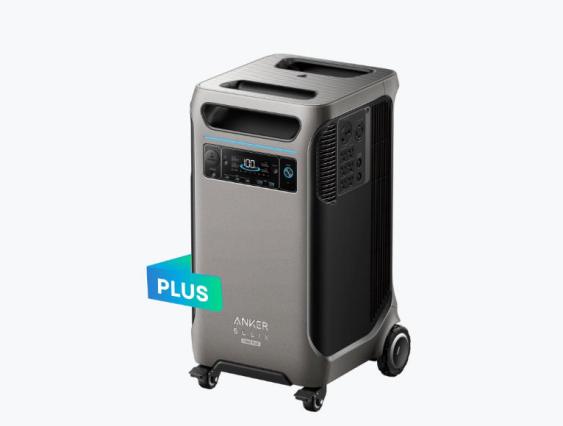
Power stations may appear similar in purpose, but their weight and size often differ dramatically. Some models are compact enough to carry with one hand, while others resemble small appliances that require wheels or built-in handles. These differences can confuse buyers who expect capacity alone to determine how large a unit should be. In practice, multiple technical factors shape how heavy or spacious a power station becomes. Battery type, inverter structure, cooling needs, safety design, and expansion capability all play a direct role in determining form. This is why high-capacity systems like the Anker SOLIX F3800 Plus Portable Power Station use a more substantial build: the internal architecture must support long runtime, high output, and multiple charging methods. Understanding the engineering behind these variations helps users choose the right device for backup power, travel, or off-grid living.
What Core Engineering Choices Influence Weight and Size?
Battery Chemistry Determines the Foundation of the Form
Battery cells represent the largest portion of a power station’s mass. Chemistries such as lithium iron phosphate (LFP) and lithium nickel manganese cobalt oxide (NMC) differ in energy density, thermal stability, and lifespan. LFP batteries weigh more per kilowatt-hour, but they offer long life and strong safety margins, making them ideal for home backup and continuous cycling. NMC batteries are lighter for the same capacity, which benefits portability but introduces different thermal and safety considerations. The total watt-hour capacity also scales the footprint: a station built to manage multi-day use must physically store more cells. This explains why large-scale models like the F3800 Plus use a sturdier housing and broader internal layout to accommodate its expandable architecture while maintaining safety and durability.
Power Output Hardware Adds Volume Beyond Batteries
High-wattage inverters, DC-DC converters, and bidirectional charging modules require space and structural support. A station designed to deliver 6,000W AC output or dual-voltage operation incorporates heavier copper wiring, larger power boards, and reinforced thermal pathways. Systems that support 120V and 240V must house additional circuitry to regulate and route power cleanly. Fast-charging features also influence weight. For example, compatibility with multiple charging methods—including solar, AC, generators, and home power panels—demands robust internal components. A model such as the F3800 Plus integrates these modules to handle solar input up to 3,200W and AC bypass charging at 240V, which naturally expands its structure.
Cooling Architecture Shapes Size for Safety and Efficiency
Cooling systems play a critical role in maintaining battery health and inverter performance. Airflow channels, heat sinks, temperature sensors, and fan assemblies all occupy internal volume. Larger stations that support continuous heavy loads require more sophisticated cooling pathways. Thick heat spreaders, multi-fan designs, and reinforced ventilation panels prevent thermal stress under heavy use, such as running an air conditioner, a well pump, or multiple appliances simultaneously. Portable units with lower output rely on smaller passive systems, reducing size but limiting performance. By contrast, a station like the F3800 Plus must support reliable operation during prolonged energy draw, so its enclosure prioritizes cooling capacity alongside electrical components.
Why Do Design Choices Affect Portability and Use Scenarios?
Structural Reinforcement Supports Expandability and Long Life
Power stations designed for modular expansion need reinforced frames, internal rails, and secure connection points. An expandable ecosystem—such as scaling from 3.84kWh to over 50kWh—cannot rely on a thin or lightweight shell. The system must maintain stability when adding external batteries or linking with home power panels. Reinforcement naturally adds weight but delivers durability and long-term reliability. The F3800 Plus uses a structure engineered for stacking, transporting, and continuous anchoring, allowing users to add capacity while ensuring electrical and mechanical safety.
User Protection and Safety Compliance Add Layers of Material
Safety standards influence everything from insulation thickness to impact resistance. Stations built for home integration or outdoor use require durable housings, internal isolation layers, and additional grounding infrastructure. Testing against shock, vibration, and weather exposure also shapes material decisions. These layers become more substantial with higher capacity models since greater stored energy requires higher protective thresholds. Lightweight travel-focused units sacrifice some of this reinforcement to remain easy to carry, which illustrates why the range of weights varies so widely in the market.
Versatile Charging Infrastructure Expands the Internal Layout
Power stations that allow multiple charging routes—solar arrays, AC outlets, generators, vehicle ports, or home panels—must house dedicated management hardware. Solar-first systems require maximum power point tracking modules and robust protection circuits. Fast AC charging requires heavy-duty input regulation. Weather-responsive features like automatic pre-storm charging add communication components and monitoring boards. The Anker SOLIX F3800 Plus integrates these capabilities, including Storm Guard automation and multiple input pathways, which increases internal complexity but greatly enhances practical use.
Conclusion
Weight and size differences among power stations are not arbitrary; they reflect the engineering trade-offs involved in battery technology, power output design, cooling requirements, safety reinforcement, and charging versatility. Lightweight units support basic electronics and portability, while larger stations are engineered for sustained high-load operation, multi-day storage, and integration with solar systems or home circuits. High-capacity solutions like the best portable power station demonstrate how more advanced components naturally contribute to a larger form while enabling powerful features such as dual-voltage output, extended expansion, and strong multi-source charging support. Understanding these design realities helps users select a model aligned with their energy expectations, mobility needs, and long-term reliability goals.





Leave a Reply